
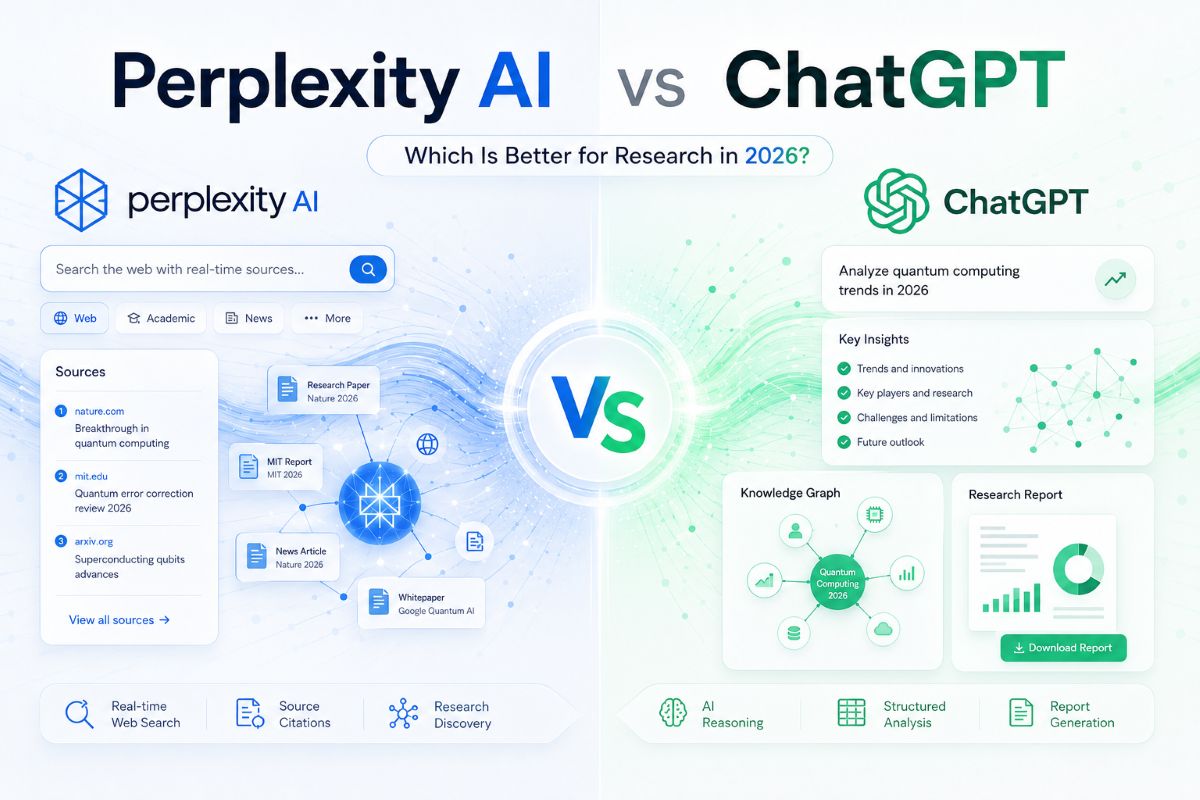
If you’ve been trying to figure out which AI tool to use for serious research, you’ve probably already landed on the same two contenders: Perplexity AI and ChatGPT. After months of using both across real research workflows ranging from market analysis to technical deep dives, the answer is less about which one is better overall and more about what you’re trying to do.
Here is my honest take on Perplexity AI vs ChatGPT 2026, tested in actual conditions.
What Makes These Two Tools Different
Perplexity AI is built as a research engine first. Every answer it gives is grounded in a live web search, with numbered citations linking directly to source pages. It uses a source-first architecture: the model pulls evidence before it generates a response. The result is a tool that behaves more like structured search than freeform chat.
ChatGPT is a general-purpose AI that has added research capabilities over time. Its Deep Research mode received major updates in February 2026, including MCP integration and real-time interruption support, and it is genuinely impressive. But research is a feature inside ChatGPT. In Perplexity, it is the whole product.
That architectural difference shows up in accuracy data and, more importantly, in how you actually work with each tool.
Accuracy and Citations: Where Perplexity Has a Structural Edge
The most relevant independent benchmark here is the Columbia Journalism Review citation audit. Perplexity’s citation hallucination rate came in at 37%. ChatGPT Search came in at 67%. That is not a small gap.
An April 2026 evaluation by LMSYS found Perplexity Pro achieved 92% factual accuracy on real-time queries, compared to ChatGPT’s 87% with browsing enabled. The gap widens on fast-moving data: Perplexity scored 94% accuracy on financial queries versus ChatGPT’s 81%, largely because Perplexity’s web index updates in near real-time while ChatGPT’s browsing layer carries a slight delay.
The reason for Perplexity’s edge is structural. When you ask it a question, it searches first and generates second. If a source does not exist or says something different, fabricating a claim is harder. ChatGPT, even with browsing enabled, has a strong training prior that can bleed into responses.
That said, neither tool is reliable without your own verification. Perplexity’s 37% citation error rate still means more than one in three citations can be inaccurate when you click through. The citations make errors easier to catch. They do not eliminate them.
Side-by-Side Feature Comparison
| Feature | Perplexity AI | ChatGPT |
|---|---|---|
| Default citations | Yes, inline and numbered | No (must explicitly request) |
| Real-time web search | Always on, all tiers | Plus and Pro plans only |
| Deep Research speed | Under 3 minutes | 5 to 30 minutes |
| Code execution | No | Yes |
| Free tier web access | Yes | No |
| Image generation | Pro tier and above | Plus tier and above |
| Pricing (main paid tier) | $20/month (Pro) | $20/month (Plus) |
| Premium tier pricing | $200/month (Max) | $200/month (Pro) |
The free tier gap is the most underappreciated difference in this Perplexity AI vs ChatGPT 2026 guide. Perplexity’s free tier includes real-time web search and up to three Deep Research queries per day. ChatGPT’s free tier has no web access. For students and budget-constrained researchers, that makes Perplexity the practical default starting point.
At the Pro level, both cost $20 per month, but the product you are buying is different. Perplexity delivers a research engine with model switching. ChatGPT delivers a creative toolkit with search as one of many features.
At the premium tier, Perplexity Max ($200/month) matches ChatGPT Pro in price but takes a different approach: 19-model orchestration including GPT-5.2 and Claude Opus 4.6, versus ChatGPT Pro’s single flagship model depth.
Perplexity AI vs ChatGPT 2026 Examples: Real Research Tasks
Market research: Asked both: “What are the top five barriers to enterprise AI adoption in 2026?” Perplexity returned a structured answer with eight numbered citations from Gartner, McKinsey, and two analyst reports, all clickable and verifiable. ChatGPT gave a more nuanced narrative answer but cited nothing unless I explicitly asked for sources. For deliverables where sourcing matters, Perplexity saved around 20 minutes per session.
Competitive analysis: Asked both to compare two SaaS pricing models. ChatGPT produced a better-formatted comparison document with more coherent prose. Perplexity found the most current pricing data faster and flagged a recent price change I would have missed with static training data.
The pattern is consistent across use cases: Perplexity for discovery and verification, ChatGPT for synthesis and written output.
Pricing Reality for Teams
At the individual level, both tools are price-matched at $20 per month for their main paid tiers.
For teams, the gap widens. ChatGPT’s Team plan at $25 per user per month undercuts Perplexity’s Enterprise Pro at $40 per user per month by 37.5%. However, Perplexity’s enterprise plan defaults to no training on user data and includes stricter data isolation controls, which matters for teams in regulated industries like healthcare and finance.
The Broader Landscape: Where Claude and Gemini Fit
The honest best Perplexity AI vs ChatGPT 2026 answer requires acknowledging that these two tools do not own the entire space.
ChatGPT holds the largest user base, with 200M+ monthly active users as of 2026 (OpenAI), which gives it the fastest-improving ecosystem and the deepest integrations. But the competition is real.
Anthropic’s Claude Opus 4.6 topped the SWE-bench coding benchmark with a 72.5% resolution rate (Anthropic, 2026), and 65% of developers prefer Claude for code review tasks over ChatGPT according to the Stack Overflow Developer Survey 2026. For anyone whose research overlaps with code analysis or documentation review, that matters.
Google’s Gemini 3.1 Pro processes up to 1M tokens per context window (Google, 2026), making it the leader for analyzing complete research papers, legal documents, or lengthy financial reports without chunking.
The AI assistant market is projected to reach $47B by 2027 (Grand View Research, 2026). That number signals a space where specialization is increasing, not converging. For pure research tasks, Perplexity leads. For code, long-document analysis, or creative writing, the most honest answer is often “Perplexity plus one other tool.”
The Verdict
For research specifically, Perplexity AI is the stronger tool in 2026. Its citation transparency, near-real-time web index, and free-tier web access give it a structural advantage that ChatGPT has not closed despite significant investment in Deep Research.
ChatGPT is the better choice when you need to do something with what you find: write a report, run code against data, build a narrative from raw research, or work through a problem conversationally over multiple sessions.
The workflow that eliminates most of the risk from either tool: use Perplexity to find and verify, use ChatGPT or Claude to synthesize and create. It takes ten minutes to set up as a habit and cuts hallucination risk significantly compared to relying on either tool alone.
Frequently Asked Questions
Is Perplexity AI better than ChatGPT for research in 2026?
For tasks requiring source citations and real-time data, yes. Perplexity’s citation hallucination rate is 37% versus ChatGPT Search’s 67% per the Columbia Journalism Review audit. For creative synthesis, writing, and coding, ChatGPT is the stronger tool.
How do I use Perplexity AI for research?
Enter your question at perplexity.ai. Use the Focus selector to restrict sources to Academic papers, Reddit, YouTube, or news depending on your need. Pro users can trigger Deep Research for a structured multi-source report in under three minutes, with clickable citations throughout.
Is Perplexity AI free?
Yes. The free tier includes real-time web search with numbered citations and three Deep Research queries per day. The Pro plan is $20 per month and adds unlimited searches, model switching, and file uploads.
Can ChatGPT replace Perplexity for research?
Not fully. ChatGPT’s Deep Research mode is capable, but it does not default to inline citations and takes 5 to 30 minutes compared to Perplexity’s sub-three-minute standard. For fast, cited fact-checking, Perplexity is structurally faster.
Which AI tool is best for academic research in 2026?
Perplexity’s Focus Academic mode filters results to peer-reviewed sources, making it the strongest free starting point for academic queries. For analyzing full research papers, Google Gemini 3.1 Pro’s 1M token context window handles complete documents without chunking.